Definition

Anatomy of the Male Abdomen and Groin

Choose a preferred language

The belly (abdomen) is the largest space (cavity) in the body. It lies between the chest and the pelvis, holding many of the body’s organs. These include the liver, stomach, and intestines.

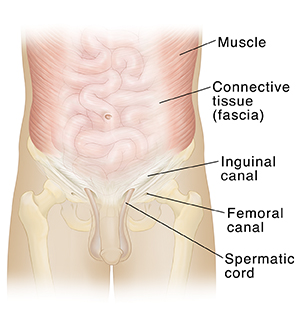
The groin is the area in the body where the upper thighs meet the lowest part of the abdomen. Normally, the abdomen and groin are kept separate by a wall of muscle and tissue. The only openings in the wall are small tunnels called the inguinal and femoral canals. These allow nerves, blood vessels, and other structures to pass between these 2 areas.
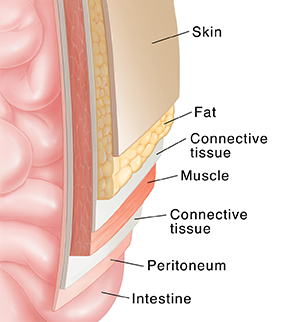
Cross section of abdominal wall over intestine showing layers: skin, fat, connective tissue, muscle, connective tissue, and peritoneum.


The abdomen and groin

  • Muscles. These are soft tissues. They enclose the intestines and other organs in the abdomen.

  • Connective tissue. These help bind the muscles together.

  • Inguinal canal. This tunnel in the groin is formed by layers of muscle and other tissues in the wall of the abdomen.

  • Femoral canal. This tunnel in the wall of the abdomen allows blood vessels and nerves to pass through the groin into the leg.

  • Spermatic cord. This passes through the inguinal canal and connects to the testicle.
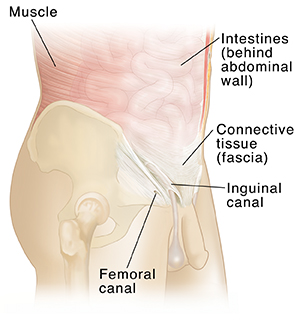
Side view of male torso showing abdominal muscles and intestines. Umbilical ring and internal inguinal ring are visible.Front view of male body showing muscles of abdomen and intestines.

Online Medical Reviewer: Jen Lehrer MD

Online Medical Reviewer: Raymond Kent Turley BSN MSN RN

Online Medical Reviewer: Rita Sather RN

Date Last Reviewed: 02/01/2025

© 2000-2025 The StayWell Company, LLC. All rights reserved. This information is not intended as a substitute for professional medical care. Always follow your healthcare professional's instructions.



Find a doctor that's right for you.

From routine check-ups to groundbreaking treatments and beyond, Crestner Health is here to help you live your healthiest life.

Search our doctors
Related Articles
Read article
Digestive Health
What Is GERD?

If you often have a painful burning feeling in your chest after you eat, you may have GERD (gastroesophageal reflux disease).

Read article
Digestive Health
How Food Moves Through Your Body

Here is an explanation of how food moves through your body and what each part of your digestive tract does.

Read article
Digestive Health
Understanding H. pylori and Ulcers

Traditionally, ulcers were thought to be caused by too much spicy food, stress, or anxiety. We now know that most ulcers are likely due to infection with bacteria known as Helicobacter pylori (H. pylori).

Read article
Digestive Health
How the Liver Works

Detailed information on how the liver works, including a full-color, labeled illustration of the digestive system

Schedule a Colon Cancer Screening

A screening is the best way to catch colorectal cancer early, when treatments is more successful.

Schedule an Appointment