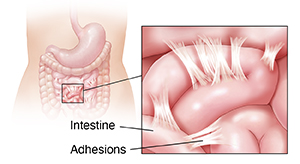
Lysis of adhesions is a surgery to cut bands of tissue that form between organs. These bands are called adhesions. They are often caused by scar tissue that formed after an earlier surgery. Adhesions can connect organs to each other.
How to say it
LY-sihs ad-HEE-shuhnz
Why lysis of adhesions is done
Adhesions can cause severe, ongoing pain. Cutting the adhesions helps ease this pain. Adhesions can also cause blockage of the intestines. This blockage can lead to serious symptoms, such as severe pain and vomiting. It can also cause long-term (permanent) damage to the intestines and can even be fatal. Adhesions in the pelvis can also cause infertility in women. Lysis of adhesions is done to prevent or treat these problems.
How lysis of adhesions is done
Lysis of adhesions may be done using laparoscopy. This method uses a few small cuts (incisions) in your belly (abdomen). Or it may be done as open surgery, with a large cut.
-
You are given medicine (general anesthesia). This puts you into a deep sleep through the procedure.
-
For a laparoscopy, the surgeon makes 2 to 4 small incisions in your belly. A long, thin, lighted tube (laparoscope) with a camera on the end is placed in one of the cuts. The tube sends pictures of your belly to a video screen. This lets your surgeon see inside your belly. Tiny surgical tools are put through the other small cuts. The surgeon fills your belly with carbon dioxide. This gas makes more room in your belly so the surgeon can see and work more easily. If open surgery is done, the surgeon makes a large cut in your belly. The laparoscope is not used.
-
The surgeon cuts and removes the adhesions. This lets the organs move more freely.
-
When the surgery is done, the scope and other tools are removed. The cuts are closed.
Risks of lysis of adhesions
Risks of this surgery include:
-
Infection.
-
Bleeding.
-
Incisional hernia.
-
Damage to abdominal organs.
-
Need to switch to open surgery.
-
Return of the adhesions.
-
Risks of anesthesia.
-
Death (rare).
Author: Michels, Karen
Online Medical Reviewer: Daphne Pierce-Smith RN MSN
Online Medical Reviewer: Lalitha Kadali Researcher
Online Medical Reviewer: Melinda Murray Ratini DO
Date Last Reviewed: 11/01/2024
© 2000-2025 The StayWell Company, LLC. All rights reserved. This information is not intended as a substitute for professional medical care. Always follow your healthcare professional's instructions.