Types

What Is Presbyopia?

Choose a preferred language

Presbyopia is the loss of close-up focusing. It's not a disease. It is a normal aging process of the eye. When you are younger, the lens in your eye changes shape to focus light directly on the back of your eye (the retina). But as you get older, the lens hardens and can't change its shape as easily. It then can’t focus clearly on close objects. This makes them look blurry.
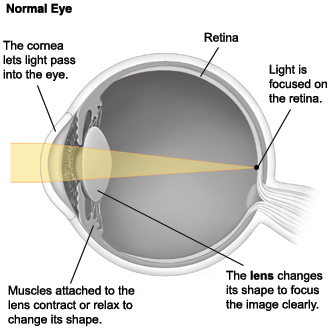
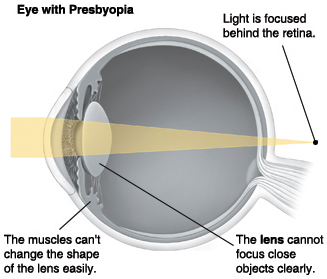
Cross section of eye showing light focusing on retina normally.Cross section of eye showing light focused behind retina.


What are the symptoms?

Presbyopia makes it hard to do things close-up. This includes reading small print, using tools, and threading a needle. The first sign may be a tired feeling when you look at something close-up. Presbyopia most often starts when you’re 40 to 45 years old. But it can start at an earlier age.

Online Medical Reviewer: Chris Haupert MD

Online Medical Reviewer: Raymond Kent Turley BSN MSN RN

Online Medical Reviewer: Rita Sather RN

Date Last Reviewed: 12/01/2022

© 2000-2025 The StayWell Company, LLC. All rights reserved. This information is not intended as a substitute for professional medical care. Always follow your healthcare professional's instructions.



Find a doctor that's right for you.

From routine check-ups to groundbreaking treatments and beyond, Crestner Health is here to help you live your healthiest life.

Search our doctors
Related Articles
Read article
Eye Care
Understanding Focusing Problems

Your vision depends on how light is focused in your eye. A look at 3 common problems with focusing that make vision blurry: farsightedness, nearsightedness, and astigmatism.

Read article
Eye Care
Conjunctivitis Caused by Irritation

Conjunctivitis may be caused by allergies or other irritants. The problem can keep coming back. Sometimes an eye infection will result. Treatment involves relieving the symptoms and avoiding the cause of the irritation.

Read article
Eye Care
Understanding herpes eye disease

Herpes eye disease is a condition caused by the herpes simplex virus. It causes redness, pain, tearing, and other symptoms in the eyes.

Read article
Eye Care
Understanding Color Blindness

Your retina has special cells that detect color. If you have a problem with these cells, you may not be able to see some colors.