It's important to care for and protect your access to help it last. A problem such as an infection or a blood clot may make your access unusable. This may happen more often with an arteriovenous graft than with an arteriovenous fistula. If this occurs, you may need a new access. Follow these guidelines to help protect your access.
Watching for problems
Call your healthcare provider right away if you:
-
Can’t feel the blood flowing in the access (this sensation is called a thrill)
-
Have pain or numbness in your hand or arm
-
Have bleeding, redness, a bluish color, or warmth around your access
-
Notice your access suddenly bulging out more than usual (a slight bulge is normal)
-
Have a fever of 100.4°F (38°C) or higher, or as advised by your provider
Follow these and any other guidelines you’re given
-
Don’t wear tight clothes or jewelry around your access.
-
Don’t let anyone take your blood pressure on or draw blood from the arm with the access. Also don’t let anyone put IV (intravenous) lines into it.
-
Protect your access from being hit or cut.
-
Wash your hands often and keep the area around the access clean.
-
Do not carry anything heavy or do anything that would put pressure on the access.
Feeling for your thrill
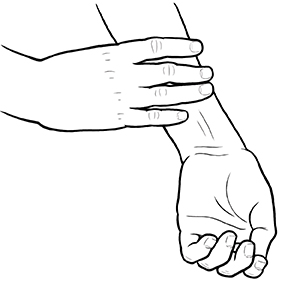
If you put your fingers over your access, you should feel the blood rushing through it. This is called a thrill, and it feels like a vibration. Feel for the thrill as often as you're told, usually once or twice a day. If you can't feel it, tell your healthcare provider right away. Blood may not be flowing through your access the way it should.
Important numbers
Write the names and numbers of your healthcare providers below or have them programed into your cellphone. That way you will know how to get in touch with them.
Healthcare Provider:
Name ___________________ Phone ___________________
Surgeon:
Name ___________________ Phone ___________________
Dialysis Center:
Name ___________________ Phone ___________________
How daily issues affect your health
Many things in your daily life impact your health. This can include transportation, money problems, housing, access to food, and child care. If you can’t get to medical appointments, you may not receive the care you need. When money is tight, it may be difficult to pay for medicines. And living far from a grocery store can make it hard to buy healthy food.
If you have concerns in any of these or other areas, talk with your healthcare team. They may know of local resources to assist you. Or they may have a staff person who can help.
Online Medical Reviewer: Marianne Fraser MSN RN
Online Medical Reviewer: Raymond Kent Turley BSN MSN RN
Online Medical Reviewer: Walead Latif MD
Date Last Reviewed: 10/01/2022
© 2000-2025 The StayWell Company, LLC. All rights reserved. This information is not intended as a substitute for professional medical care. Always follow your healthcare professional's instructions.
Find a cardiac specialist
Because every beat matters, our cardiac doctors are dedicated to providing care like no other can.
Related Articles
Hemodialysis Discharge
Hemodialysis is a treatment that takes over the essential functions of the kidney until you recover from the kidney disease, or obtain a kidney transplant. If you have end stage renal disease and are not eligible for a transplant, you will need to have hemodialysis for the rest of your life.
Living with Your Central Venous Catheter for Hemodialysis
Learn helpful everyday tips to ensure your central venous catheter stays clean, infection free, and in good working order.
Hemodialysis
Hemodialysis is a type of procedure that involves the patient being connected to a machine to clean their blood of any excess fluid or waste material. On average, each session of hemodialysis lasts 4 hours and must be done three times a week in a dialysis center. Learn more about hemodialysis by watching this program.
Preventing Kidney Stones
If you've had a kidney stone, you may worry that you'll have another. Removing or passing your stone doesn't prevent future stones. But with your health care provider's help you can reduce your risk of forming new stones.