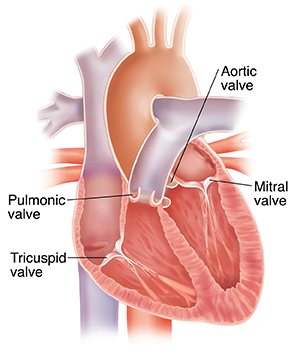
The heart has four valves. They are the aortic, pulmonary, tricuspid, and mitral valves. The valves open and close to keep blood moving in the right direction through the heart. Blood moves through the heart as it beats. With each squeeze, the valves open and close to keep blood moving forward. In this way, valves keep blood moving as well as possible through the heart. They also prevent backflow.
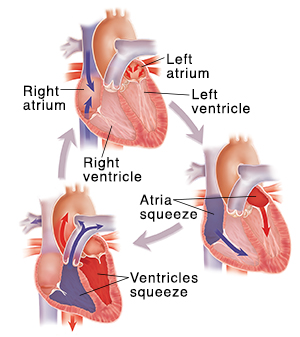
When the heart relaxes between beats:
-
Oxygen-rich blood from the lungs fills the left atrium.
-
Oxygen-poor blood from the body fills the right atrium.
When the atria beat:
-
The left atrium squeezes. This pushes blood through the mitral valve into the left ventricle.
-
The right atrium squeezes. This pushes blood through the tricuspid valve into the right ventricle.
When the ventricles beat:
-
The left ventricle squeezes. This pushes blood through the aortic valve out to the heart arteries, the brain, and body.
-
The right ventricle squeezes. This pushes blood through the pulmonary valve to the lungs.

Find a cardiac specialist
Because every beat matters, our cardiac doctors are dedicated to providing care like no other can.
Related Articles
Right-Sided Heart Failure
Swelling in the feet and ankles is one of the first signs of right-sided heart failure. Learn how this condition is treated.
Ventricular Arrhythmia
Sometimes problems with the heart's electrical signals lead to a fast heart rhythm. Too many signals may make the heart beat very fast (tachycardia). Or signals may be sent so rapidly and irregularly that the heart muscle sometimes quivers and doesn't beat at all (fibrillation).
What Is Cardiac Asthma?
Cardiac asthma can the same symptoms as true asthma. But the symptoms are caused by heart failure, which leads to fluid buildup in the lungs.
The Cardiologist
A cardiologist is a healthcare provider who has had extra training to treat problems of the heart and blood vessels. These include heart attack and heart failure.


