When you have COVID-19, lying on your belly can help your lungs work better. It can help get more oxygen into your lungs more easily. It can help prevent lung injury. Lying on your belly is known as the prone position. You may also hear it called proning. If you’re in the hospital, the health care team may position you to help your lungs. When you are strong enough, your health care team may want you to do these position changes on your own.
How does proning help you breathe?
Most of your lung tissue sits closer to your back than to your front. Lying on your back (supine) can put pressure on your lung tissue. This can make the small air sacs in your lungs work harder to inflate. If you have to breathe harder to get enough air in your lungs, this can make lung problems worse. It can also cause lung injury.
But lying on your stomach (prone) can help your lungs work better with less stress. It can help prevent problems, such as a collapsed lung. This is when the air sacs in the lung can’t inflate, or they may fill with fluid. It can happen to part or all of one or both lungs. Lying on your side can also help your lungs work better. Part of your time in bed will be spent on your side as well.
If you're in the hospital
If you’re awake and still in the hospital, the health care team will help position you if needed. They can show you the safest ways to turn over while you’re connected to tubes, such as an IV. Your blood oxygen level (oxygen saturation, or O2 sat) may be checked often. This is to make sure your lungs are getting enough oxygen into your body. Your O2 sat level may be checked after each time you change position.
Getting ready for proning at home
Before you do prone positioning at home, tell your health care provider if you have any of these:
-
Neck, spine, or pelvic pain or other problems
-
Acid reflux from your stomach (heartburn or GERD)
-
Nausea or vomiting
You’ll need:
-
A bed surface that can be flat
-
Pillows
-
A towel you can roll up
Before you get into bed:
-
Use the bathroom. This is so you don’t have to get up soon after you’re lying down.
-
Make sure you have things in reach that you need. This includes your phone, TV remote, book or magazine, or a bell to ring for a family member.
Changing positions over time
You will need to cycle through these positions. Repeat this cycle as often as your health care team advises. Do them in this order:
|
Proning cycle |
|
|
|
|
|
|
|
|
|
|

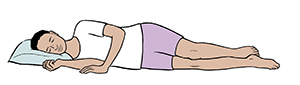
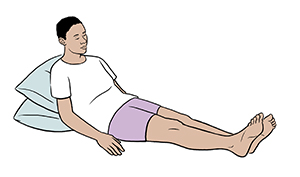

Making proning more comfortable for you
-
Place pillows under your hips or lower legs as needed for comfort. If you have large breasts or a large belly, you can place pillows on your upper chest and pelvis to help support these areas while prone.
-
Put a pillow under your head. Turn your head from side to side at least once every 30 minutes, or more often as needed.
-
If you have neck problems, you can fold a towel into a horseshoe shape to support your face. This will let you lie face down without turning your head to the side.
-
Try putting your arms in different positions to see what is most comfortable. To start, try putting one arm bent and the other straight.
-
Don’t lie on your stomach if you’ve just had a meal. This can cause stomach acid reflux. Try to wait a couple of hours after eating before you lie on your belly.
-
Change position slowly and carefully. If you have an IV or other tubes, make sure to not pull on them.
-
Change position more often if you are at risk for pressure sores (ulcers).
Follow your health care team's directions
The information above is a guideline. Make sure to follow your health care team’s specific directions. They may tell you:
-
When to do proning.
-
How often to do proning.
-
How often to change position.
When to contact your doctor
Contact your health care provider if you any of the following occur:
-
Breathing that gets worse
-
New or worse neck, spine, or pelvic pain from proning
-
New or worse acid reflux
-
New chest pain
Date Last Reviewed: 04/01/2025
© 2000-2025 The StayWell Company, LLC. All rights reserved. This information is not intended as a substitute for professional medical care. Always follow your healthcare professional's instructions.