Dismiss Modal

Definition

Anatomy of the Sacroiliac Joint

Choose a preferred language

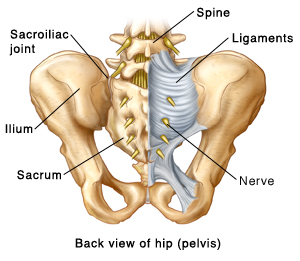
There are 2 sacroiliac (SI) joints. They are in the very low back (buttocks area). There is 1 joint on either side of the pelvis. The SI joints link the sacrum to the ilium. The sacrum is a triangular bone at the bottom of the spine. The ilium is part of the pelvis. The SI joints are held in place by ligaments. Ligaments are strong tissue that link bone to bone. The joints don't move very much. But they do help with mobility. They work with your spine and femurs to help you bend and walk. They also help bear the weight of your upper body.
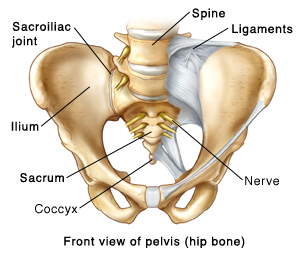
Front view of the pelvis (hip bone) showing the sacroiliac joint showing the spine, ligaments, ilium, sacrum, coccyx, and nerve.

Back view of the hip (pelvis) showing the sacroiliac joint, spine, ligaments, ilium, sacrum, and nerve.

© 2000-2025 The StayWell Company, LLC. All rights reserved. This information is not intended as a substitute for professional medical care. Always follow your healthcare professional's instructions.


Related Articles
Read article
Orthopedics
Anatomy of a Normal Spine

Learn about the spine with these helpful detailed illustrations.

Read article
Orthopedics
Shoulder Immobilizer

A shoulder immobilizer is designed to hold your arm against your body. It is used for injuries where you need to limit how much you can move your shoulder. These injuries include a shoulder dislocation or shoulder fracture. Moving your shoulder too much could cause harm.

Read article
Orthopedics
Closed Toe Fracture

Toe fractures cause local pain, swelling, and bruising. These injuries take about 4 weeks to heal. Toe injuries are often treated by taping the injured toe to the next one. This protects the injured toe and holds it in position.

Read article
Orthopedics
Kneecap Surgery: Removing Damaged Cartilage

Surgery may be used when pain severely limits your activities. Or it may be done when a rehab program or other nonsurgical treatments just are not helping enough. Some procedures may be done using arthroscopy. This method uses tiny incisions and special instruments to look and work inside the knee joint. Other procedures need open surgery.

Our orthopedic specialists will get you moving pain-free again.

From orthopedic surgeons to physical therapists, our orthopedic team has been built to provide seamless care and support throughout your whole journey.

Browse our specialists