Dismiss Modal

Definition

Skeletal Growth (Child)

Choose a preferred language


A skeleton in progress

  • In babies, the bones in the head aren't fused together. This allows the head to be flexible so it can pass through the birth canal during childbirth. The bones in the skull don’t fully fuse until ages 1 to 2.

  • Children have more dense, elastic tissue (called cartilage) in their joints and other bony structures (such as the ribs). This allows the bones to continue to develop and grow as the child grows. This extra cartilage develops into bone over time. By about age  16, most extra cartilage has matured into bone.

  • Children have growth plates in each long bone. A growth plate is an area of soft bone at each end of the long bones. Growth plates allow the bone to grow as the child grows. The growth plates fuse by the time a child is  14 to 18 years old. 
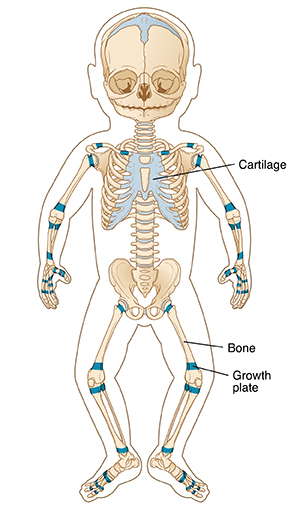
    Front view of infant showing skeleton and growth plates.

Featured in

© 2000-2025 The StayWell Company, LLC. All rights reserved. This information is not intended as a substitute for professional medical care. Always follow your healthcare professional's instructions.


Related Articles
Read article
Orthopedics
Your Child's Feet

Having strong, healthy feet allows your child to walk, run, and play. Read on to learn what to expect with your baby's and toddler's developing feet.

Read article
Hematology
High-Risk Newborn Blood Disorders

Detailed information on blood disorders that place a newborn at higher risk and require clinical care by a physician or other healthcare professional

Read article
Hematology
Polycythemia Vera in Children

Polycythemia vera is a serious, but very rare blood disorder in children. Learn about causes, symptoms, diagnosis, and treatment.

Read article
Genetic and Congenital Conditions
When Your Child Has Legg-Calvé-Perthes Disease

Your child has been diagnosed with Legg-Calvé-Perthes (LCP) disease. This is a problem with the head of the thighbone (femoral head). With LCP disease, the blood supply to the femoral head stops. Learn more about causes, symptoms, diagnosis, and treatment.

Our orthopedic specialists will get you moving pain-free again.

From orthopedic surgeons to physical therapists, our orthopedic team has been built to provide seamless care and support throughout your whole journey.

Browse our specialists