Treatment will depend on how bad your sprain is. For a severe sprain, healing may take
Right after your injury: Use R.I.C.E.
-
Rest: At first, keep weight off the ankle as much as you can. You may be given crutches to help you walk without putting weight on the ankle.
-
Ice: Put an ice pack on the ankle for up to
20 minutes at a time. Don't put ice directly on your skin. To protect your skin and prevent skin damage, wrap the bag in a clean, thin towel or cloth. Remove the pack and reapply every2 to 3 hours or as directed by your healthcare provider. Repeat for up to3 days. This helps reduce swelling. -
Compression: To reduce swelling and keep the joint stable, you may need to wrap the ankle with an elastic bandage. For more severe sprains, you may need an ankle brace, a boot, or a cast.
-
Elevation: To reduce swelling, keep your ankle raised above your heart when you sit or lie down.
Medicine
Your healthcare provider may suggest oral nonsteroidal anti-inflammatory drugs (NSAIDs), such as ibuprofen. This relieves the pain and helps reduce swelling. Be sure to take your medicine as directed.
Exercises
You may be given exercises to strengthen the ligaments and muscles in the ankle. Doing these exercises will help prevent another ankle sprain. Your healthcare provider may also refer you to a physical therapist. A physical therapist can help develop a rehabilitation program aimed at rebuilding strength and range of motion of your ankle and help treat pain. Ask your healthcare provider when it is safe to begin exercises.
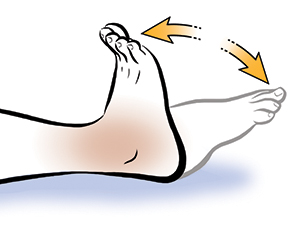
Range of motion exercise:
-
While sitting, use the big toe of the injured foot to trace the alphabet (upper- and lower-case). Do this for
2 to 3 minutes3 times per day.
Online Medical Reviewer: Rahul Banerjee MD
Online Medical Reviewer: Ronald Karlin MD
Online Medical Reviewer: Stacey Wojcik MBA BSN RN
Date Last Reviewed: 08/01/2023
© 2000-2025 The StayWell Company, LLC. All rights reserved. This information is not intended as a substitute for professional medical care. Always follow your healthcare professional's instructions.