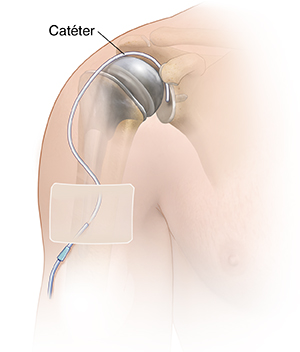
Puede haber infección después del reemplazo de una articulación. Para tratarla, pueden enviarse antibióticos directamente a la articulación por una sonda pequeña y delgada llamada catéter. El catéter se coloca mediante un procedimiento quirúrgico. Lo dejarán allí colocado por varias semanas.
¿Por qué se hace el tratamiento con antibióticos a través de un catéter para una infección articular?
La infección que puede surgir después del reemplazo de una articulación puede dañar la articulación nueva. A menudo, esta infección necesita varias semanas de tratamiento con antibióticos. Para que los antibióticos funcionen mejor y con más rapidez, se administran directamente en la articulación. Para eso, se usa un tubo blando llamado catéter o sonda. Le introducirán ese catéter en la articulación y lo sujetarán en su lugar. Permanecerá colocado en la articulación hasta que ya no se necesite.
¿Cómo se hace el tratamiento con antibióticos a través de un catéter para una infección articular?
-
El cirujano hace un pequeño corte (incisión) sobre la articulación.
-
Introduce el catéter a través de una incisión en la articulación. En general, se usan suturas para mantener el catéter en su lugar.
-
El cirujano cose la piel alrededor del catéter para cerrarla.
-
A través del catéter, le enviarán un líquido que contiene medicamentos antibióticos hacia la articulación.
-
Este catéter quedará colocado hasta finalizar el tratamiento y que el catéter deje de ser necesario. Luego, el cirujano lo quitará en un segundo procedimiento.
Riesgos del tratamiento con antibióticos a través de un catéter para una infección articular
-
Infección
-
Sangrado
-
Coágulos de sangre
-
El catéter se sale de la articulación y es necesario reemplazarlo
Author: Michels, Karen
© 2000-2025 The StayWell Company, LLC. All rights reserved. This information is not intended as a substitute for professional medical care. Always follow your healthcare professional's instructions.