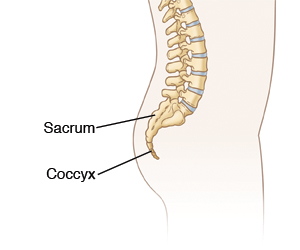
You have a bruise (contusion) of the tailbone (coccyx) or sacrum. The sacrum is the triangular bone at the base of the spine that joins the pelvic bones. The coccyx is the last bone of the sacrum that hangs down in a point like a small tail. Symptoms include swelling and some bleeding under the skin. This injury often takes a few weeks to heal. During that time, the bruise will often change in color. It may go from red to purple-blue, to green-yellow, and then to yellow-brown. A crack (fracture) in the coccyx bone causes the same symptoms as a contusion in this area. X-rays are often not taken because the treatment is the same. If you have a fracture of the tailbone as well as a contusion, healing generally takes 4 weeks or longer.
Home care
-
Try to find a position of comfort. Try lying on your side with your knees bent up toward your chest and a pillow between your knees.
-
A bruised tailbone causes pain when sitting. You may try using a doughnut pillow. This is a foam pillow with a hole in the center to prevent pressure on the tailbone. You can buy this at a pharmacy or orthopedic supply store.
-
Ice the injured area to help reduce pain and swelling. Wrap a cold source (ice pack or ice cubes in a plastic bag that seals at the top) in a thin towel. Don't place ice directly on your skin. Apply to the bruised area for 20 minutes every 1 to 2 hours on the first day. Continue this 3 to 4 times a day until the pain and swelling goes away.
-
Unless another medicine was prescribed, you can take acetaminophen, ibuprofen, or naproxen to control pain. Talk with your health care provider before taking these medicines if you have chronic liver or kidney disease, or if you ever had a stomach ulcer or digestive bleeding.
Follow-up care
Follow up with your health care provider, or as advised. Call if you don't get better in 2 weeks.
When to get medical advice
Contact your health care provider right away if you have any of the following. These may suggest that something more serious than a bruise has occurred:
-
Pain or swelling gets worse.
-
Pain spreads to one or both legs.
-
Weakness or numbness in one or both legs.
-
Loss of bowel or bladder control.
-
Numbness in the groin area.
-
Signs of infection. These include warmth, fluid leaking, or increased redness.
-
Frequent bruising for unknown reasons.
Online Medical Reviewer: Eric Perez MD
Online Medical Reviewer: Marianne Fraser MSN RN
Online Medical Reviewer: Ronald Karlin MD
Date Last Reviewed: 12/01/2024
© 2000-2025 The StayWell Company, LLC. All rights reserved. This information is not intended as a substitute for professional medical care. Always follow your healthcare professional's instructions.