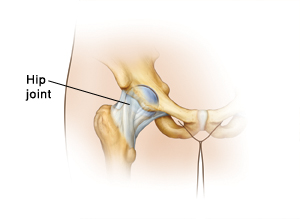
You have a strain of the muscles around the hip joint. A muscle strain is a stretching or tearing of muscle fibers. This causes pain, especially when you move that muscle. There may also be some swelling and bruising.
Home care
-
Stay off the injured leg as much as possible until you can walk on it without pain. If you have a lot of pain with walking, crutches or a walker may be prescribed. These can be rented or purchased at many pharmacies and surgical or orthopedic supply stores. Follow your health care provider's advice about when to start putting weight on that leg.
-
Apply an ice pack over the injured area for 15 to 20 minutes every 3 to 6 hours. Do this for the first 24 to 48 hours. To make an ice pack, place ice cubes in a plastic bag that seals at the top. Wrap the bag in a thin towel. Be careful not to injure your skin with the ice treatments. Ice should never be applied directly to skin. Continue to use ice packs to ease pain and swelling as needed. After 72 hours, apply heat (warm shower or warm bath) for 15 to 20 minutes several times a day, or alternate ice and heat.
-
You may use over-the-counter pain medicine to control pain, unless another pain medicine was prescribed. If you have chronic liver or kidney disease, ever had a stomach ulcer or gastrointestinal bleeding, or take a blood thinner, talk with your provider before using these medicines.
-
If you play sports, you may resume these activities when you are able to hop and run on the injured leg without pain.
Follow-up care
Follow up with your health care provider as advised. If your symptoms don't start to get better after a week, more tests may be needed.
If X-rays were taken, you will be told of any new findings that may affect your care.
When to get medical advice
Contact your health care provider right away if you:
-
Have increased swelling or bruising.
-
Have increased pain.
-
Lose the ability to put weight on the injured side.
Online Medical Reviewer: Louise Cunningham RN BSN
Online Medical Reviewer: Raymond Turley Jr PA-C
Online Medical Reviewer: Thomas N Joseph MD
Date Last Reviewed: 01/01/2025
© 2000-2025 The StayWell Company, LLC. All rights reserved. This information is not intended as a substitute for professional medical care. Always follow your healthcare professional's instructions.

