Children often get an earache. Treatment may or may not be needed. It's best to check with your child's health care provider. Ear pain can be caused by a problem in the outer or middle ear. Or it can be someplace else, such as an infected throat. Usually, outer ear problems don't cause fever. But this isn't always the case.
What are outer ear problems?
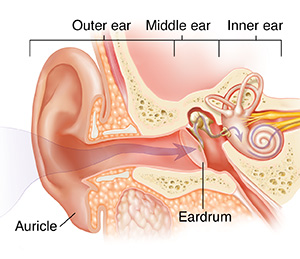
Outer ear problems occur in the area between the external part of the ear (auricle) and the eardrum. The eardrum is the thin sheet of tissue that passes sound waves between the outer and middle ear. These problems are often because of excess earwax buildup or infection.
When to call your child's health care provider
Call your child's health care provider if you're unsure or if your child is young. It’s likely an outer ear problem if you can say yes to any of the following:
-
My child’s outer ear aches or feels blocked.
-
The pain gets worse when I wiggle, pull, or move my child’s ear.
-
My child's outer ear is red or swollen.
-
My child went swimming recently.
-
My child has drainage (fluid or pus) in an ear.
-
My child's ear is itching.
-
My child has trouble hearing.
Online Medical Reviewer: Daphne Pierce-Smith RN MSN
Online Medical Reviewer: Marianne Fraser MSN RN
Online Medical Reviewer: Sravani Chintapalli Researcher
Date Last Reviewed: 02/01/2025
© 2000-2025 The StayWell Company, LLC. All rights reserved. This information is not intended as a substitute for professional medical care. Always follow your healthcare professional's instructions.