The first symptom of a brain aneurysm is often a sudden, severe headache. Many people describe it as the worst headache of their lives. Your healthcare provider will give you a physical exam and ask about your health history. If they think you may have a brain aneurysm, tests can confirm it. Test results can also help you and your healthcare team plan treatment.
CT scan
A CT scan is a fast test that creates an image of your brain. It shows if any blood has leaked around or into your brain. In some cases, CT angiography may be done. This test creates an enhanced image that can show a brain aneurysm. For the test, a contrast fluid is injected into your vein. This fluid travels to your brain arteries. Then the CT scan is done to find bleeding or other problems.
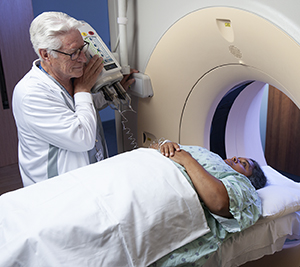
MRI scan
An MRI scan uses a computer, radio waves, and a strong magnetic field. It creates detailed pictures of the brain. MR angiography is done similarly to CT angiography and creates detailed images of blood vessels.
Spinal tap (lumbar puncture)
Cerebrospinal fluid (CSF) flows in and around your brain. It also flows around your spinal cord. A spinal tap can be done to show if blood has leaked into your CSF. Your healthcare provider numbs your lower back with a local pain medicine. Then they insert a needle into your lower spine. Fluid is removed through the needle. The fluid is examined to check for blood and signs of other problems, such as infection.
Angiogram (arteriogram)
An arteriogram shows the size, shape, and location of an aneurysm. It can also show if you have vasospasm. Vasospasm is a type of narrowing of blood vessels. This can occur after an aneurysm tears. It limits the blood flow to your brain. For this procedure, you receive a local pain medicine. Then, your healthcare provider guides a thin tube (catheter) through your arteries. The catheter is gently moved from an artery in your groin up into your neck. Contrast fluid is released in the tube. It travels to your brain. X-rays are then taken. These show your arteries and any aneurysms. This test has some risks. Your provider will explain them before the test. An angiogram is part of endovascular treatment of an aneurysm. That treatment coils and stents the aneurysm. If you have vasospasm, treatments to limit its effects can be used during the angiogram.