The Stretta procedure is a treatment for GERD (gastroesophageal reflux disease) that doesn't involve surgery. It uses heat waves to strengthen the muscles around the lower esophageal sphincter (LES), so it opens less often. This helps prevent GERD.
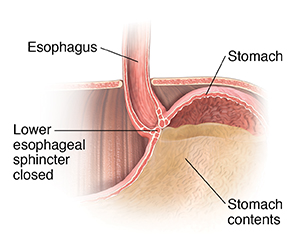
The LES is a muscular ring that connects the esophagus to the stomach. The LES normally opens when you swallow. It lets food enter your stomach, then closes. It also opens to let you burp. But when you have GERD, the LES can't open or close correctly. Fluids and stomach acid can flow from the stomach back into the esophagus. Stomach acid can hurt the esophagus and lead to long-term problems.
Why the Stretta procedure is done
The Stretta procedure may be advised if you have GERD and you:
-
Don’t get enough relief from GERD medicines.
-
Can’t take GERD medicines.
-
Don’t want to take GERD medicines long-term.
-
Want to try a nonsurgical procedure for GERD.
How the Stretta procedure is done
The Stretta procedure is most often done on an outpatient basis. That means that you go home the same day. During the procedure:
-
You're given medicine (anesthesia) to help you relax and to prevent pain. You may also sleep lightly during the procedure.
-
The health care provider puts a thin, lighted tube (endoscope) into your mouth. They pass the tube down your throat and into the esophagus to your stomach. The tube sends live images to a video screen. Measurements are taken and the endoscope is removed.
-
The provider puts a tube with wires in it (catheter system) into your mouth. The tube is moved down your esophagus to the LES. The wires in the tube carry controlled levels of radio-frequency energy to the LES in the lower esophagus and upper stomach. This heats up the tissues of the LES and makes them tighten.
-
When the procedure is done, the wires and tube are removed.
After the procedure, it takes several weeks or longer before GERD symptoms start to improve.
Risks of the Stretta procedure
Risks of the procedure include:
-
Bleeding.
-
Infection.
-
Irritation of the esophagus.
-
A hole (perforation) in the esophagus.
-
Trouble swallowing.
-
Chest pain.
-
Problems from the anesthesia.
Featured in
Author: Michels, Karen
© 2000-2025 The StayWell Company, LLC. All rights reserved. This information is not intended as a substitute for professional medical care. Always follow your healthcare professional's instructions.