A cataract is a clouding of the lens. Surgery can be done to remove the cloudy lens. It's then replaced with a clear plastic lens called an IOL (intraocular lens). The IOL can be placed either in front of or behind the colored part of your eye (the iris). Your eye care provider will choose the location that is best. This will depend on the condition of the capsule, the thin membrane that surrounds the lens. It will also depend on the type of IOL that will be implanted. An IOL doesn’t change how your eye looks, but it may improve your vision.
Posterior capsule lens
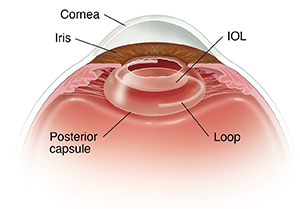
In most cases, an IOL is implanted behind the iris (posterior chamber). Flexible loops hold the IOL in place. The posterior capsule and capsular bag also provide support for the IOL.
Anterior chamber lens
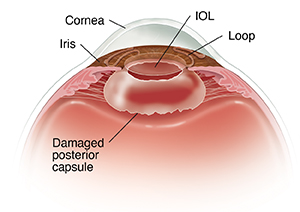
Your eye care provider may place a special lens in front of the iris (anterior chamber). This is done if the capsule behind the lens is weak or damaged. Small loops hold the IOL in place.
Scleral-fixated lens
In some cases, the capsule can't support an IOL. But your surgeon may prefer to place the IOL behind the iris rather than in front of it. In these cases, your surgeon may use stitches or place the flexible loops in the sclera (the white of the eye) to hold the IOL in place.
Types of IOLs
Your eye care provider will select a new lens to fit your eye and vision needs. IOLs are made in slightly different shapes. The IOL will generally last for the rest of your life. Talk with your provider about which lenses are right for you. Some things to consider include:
-
Special materials. IOLs are made of materials that won’t irritate your eye. These include silicone and acrylic. There's also a type of hard plastic called PMMA.
-
Foldable lenses. Many IOLs can be folded. This allows them to be inserted through small cuts (incisions) in the cornea. Or they may go in the white part of your eye.
-
Toric lenses. These lenses are used to correct astigmatism. This condition is caused by an uneven curve in the cornea or natural lens.
-
Multifocal and accommodating lenses. These lenses use advanced technology to improve your range of vision. This includes seeing up close. They are put into both eyes for best results.