Dismiss Modal

Definition

Understanding Conception

Choose a preferred language

Pregnancy begins when a woman’s egg and a man’s sperm join. This is called conception or fertilization.

Gender words are used here to talk about anatomy and health risk. Please use this information in a way that works best for you and your provider as you talk about your care.


The woman’s role in conception

Each month, one of a woman’s ovaries releases a mature egg (ovulation). The egg travels to the fallopian tube. If sperm are present, one of them may join with the egg to form an embryo. The embryo then travels to the uterus. There, it implants in the uterine lining, where it grows to become a baby. If conception doesn’t occur, the egg and the uterine lining are shed during your period (menstruation). A new cycle begins.
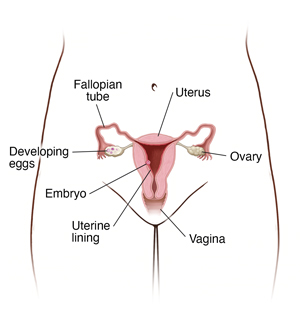
Front view of woman's pelvis showing cross section of uterus, ovaries, cervix, vagina, and fallopian tubes. Embryo is implanted in wall of uterus.


The man’s role in conception

Sperm are made in a man’s testicles. Fluid made by the prostate gland combines with sperm to form semen. During a man’s orgasm, semen flows to the urethra and out of the penis (ejaculation). If the semen was ejaculated in or near a woman’s vagina, sperm may travel into the uterus and the fallopian tubes. There, a sperm may join a mature egg to form an embryo. This results in pregnancy.
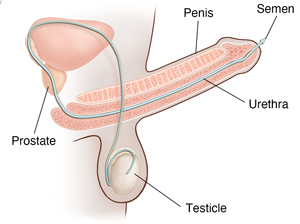

Side view of male reproductive anatomy with erect penis showing path of sperm.

© 2000-2025 The StayWell Company, LLC. All rights reserved. This information is not intended as a substitute for professional medical care. Always follow your healthcare professional's instructions.

Find a doctor that's right for you.

From routine check-ups to groundbreaking treatments and beyond, Crestner Health is here to help you live your healthiest life.

Search our doctors
Related Articles
Read article
OB/GYN
Pregnancy

Your exam today shows that you are pregnant. During pregnancy your body's hormones change. This causes physical and emotional changes. This is normal. Knowing what to expect is important for your peace of mind and so you know when to get help for a problem.

Read article
OB/GYN
Discharge Instructions for Hydatidiform Mole

You have been diagnosed with a hydatidiform mole (also called a molar pregnancy). You and your healthcare provider have decided on dilatation and curettage (D&C) to remove the mole. Here are guidelines to follow at home after the procedure.

Read article
OB/GYN
Methotrexate for Ectopic Pregnancy

An ectopic pregnancy means the baby is growing outside the uterus, most often in the fallopian tube. The fetus can't survive in the fallopian tube. There is no way to save the fetus in this situation. An ectopic pregnancy is a very serious condition. Treatment with methotrexate is an alternative to surgery. Read on to learn more.

Read article
OB/GYN
Diabetes: After Delivery (Postpartum)

Pregnancy changes your body in many ways. If you have diabetes, pregnancy can also change how your body uses insulin. You’ll need to adapt your diabetes management plan before, during, and after giving birth. Your healthcare provider will work with you to help you keep diabetes under control during this exciting time.