Dismiss Modal

Treatment

Anesthesia Options for Labor

Choose a preferred language

Anesthesia is a type of medicine to prevent pain. It's often used in labor. It may numb only one region of your body. This is called regional anesthesia. Or it may let you sleep during surgery. This is called general anesthesia. Only a trained specialist gives this type of medicine. When possible, your healthcare provider will use regional anesthesia. This is so you can be awake during your baby’s birth. The type of anesthetic you have may depend on the hospital guidelines.
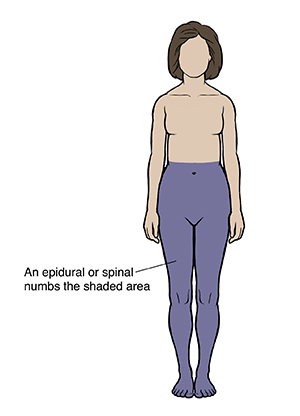
Silhouette of woman with shaded area from waist to feet.


Regional anesthesia

Your healthcare provider may use regional anesthesia to numb your lower body for a vaginal or cesarean section (C-section). It does not go into your bloodstream. This means that little or none of it will reach your baby. There are 2 kinds:

  • Epidural. This is most often given while you sit up or lie on your side. A needle with a flexible tube (catheter) is put into your lower back. The needle is then removed. The anesthetic is sent through the catheter. A small pump may be attached. This gives you a constant level of anesthetic. An epidural often affects only part of your muscle control. This means you should still be able to push for a vaginal birth.

  • Spinal. This is most often given in a single dose right before delivery. Your healthcare provider may use it for a C-section. It acts fast. You may sit up or lie down when it's injected. It may affect muscle control in your lower body. This includes your ability to push.


General anesthesia

General anesthesia lets you sleep and keeps you free from pain during surgery. Itss most often used for an emergency C-section. Your healthcare provider may use it for a scheduled C-section. They may give it to you as an injection, as an inhaled gas, or as both. Delivery often happens before the medicine has reached the baby.

© 2000-2025 The StayWell Company, LLC. All rights reserved. This information is not intended as a substitute for professional medical care. Always follow your healthcare professional's instructions.

Find a doctor that's right for you.

From routine check-ups to groundbreaking treatments and beyond, Crestner Health is here to help you live your healthiest life.

Search our doctors
Related Articles
Read article
OB/GYN
If Your Baby Is Breech: External Cephalic Version (ECV)

If your baby doesn't move into a head-first position on their own, your healthcare provider may attempt to do an external version. Your healthcare provider will try to rotate your baby by pressing down on your belly. Your healthcare provider may give you medicine to relax your uterus. This can make it easier for them to rotate your baby. During a version, your healthcare provider will use ultrasound to watch your baby.

Read article
OB/GYN
Methotrexate for Ectopic Pregnancy

An ectopic pregnancy means the baby is growing outside the uterus, most often in the fallopian tube. The fetus can't survive in the fallopian tube. There is no way to save the fetus in this situation. An ectopic pregnancy is a very serious condition. Treatment with methotrexate is an alternative to surgery. Read on to learn more.

Read article
OB/GYN
Reasons for a Cesarean Section Birth

In most cases, a cesarean section birth is not expected. It may be needed because of concerns about the baby, the mother, or the baby's passage through the birth canal.

Read article
OB/GYN
Labor: Preparing for the Hospital

You may be told to call your healthcare provider when it becomes hard to walk or talk during contractions or if your amniotic sac breaks.