Dismiss Modal

Treatment

How Electrothermal Catheter Therapy Works

Choose a preferred language

Low back and leg pain is often because of damage to 1 or more of the disks between the vertebrae. Electrothermal therapy uses heat to change the structure of the tissue inside the disk. It doesn’t relieve pain right away. Pain is reduced as the disk heals. After healing, the disk may also be stronger and more stable than before. This treatment is also called intradiscal electrothermal therapy.


Inside the disk

First, a needle is inserted into the disk. Then a special flexible wire (catheter) is threaded through the needle, so that it curves around the inside of the disk. When the catheter is in place, part of it is next to the damage in the disk.
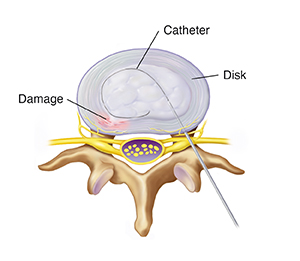
Top view of lumbar vertebra and disk showing needle inserting cathether into disk.


Heating the disk

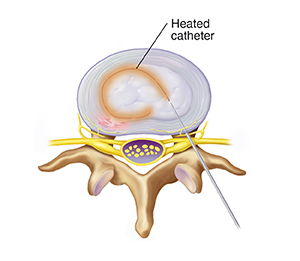
Once the catheter is in place, it's heated slowly to a high temperature. The catheter is kept at that temperature for a few minutes. Then it's removed. The heat may deaden nerves in the disk, preventing these nerves from causing pain. The heat may also make the disk shrink. This may mean that the disk no longer presses on nerves. The heated tissue will slowly heal over the next few months and form scar tissue. This scar tissue may:

  • Plug any leak in the disk

  • Make the disk stronger

    Top view of lumbar vertebra and disk showing cathether heating disk.


Risks and possible complications

The risks and complications of electrothermal catheter therapy include:

  • Bleeding

  • Spinal fluid leak

  • Infection

  • Nerve damage

  • Worsened pain after recovery

  • No improvement of pain

© 2000-2025 The StayWell Company, LLC. All rights reserved. This information is not intended as a substitute for professional medical care. Always follow your healthcare professional's instructions.
Related Articles
Read article
Orthopedics
Treatment for Bone Bruise (Bone Contusion)

A bone bruise is an injury to a bone that is less severe than a bone fracture. Bone bruises are fairly common. They can happen to people of all ages.

Read article
Orthopedics
Trigger Point Injection

If you have muscle pain or spasms, it may be due to a trigger point, which is a tight, painful knot of muscle fiber. Your health care provider can inject medicine into the trigger point to ease pain.

Read article
Orthopedics
Total Knee Replacement

During total knee replacement surgery, your damaged knee joint is replaced with an artificial joint (called a prosthesis). This surgery almost always reduces joint pain and improves your quality of life.

Read article
Orthopedics
Wrist Arthroscopy: Conditions Treated

Wrist arthroscopy is used for diagnosis and treatment. It works best for showing ligament tears, damage to the triangular fibrocartilage complex (TFCC), or joint cartilage.

Our orthopedic specialists will get you moving pain-free again.

From orthopedic surgeons to physical therapists, our orthopedic team has been built to provide seamless care and support throughout your whole journey.

Browse our specialists