Meniscal transplant surgery is done to replace a small piece of missing or damaged cartilage in the knee. It's replaced with one from a cadaver donor.
What is the meniscus?
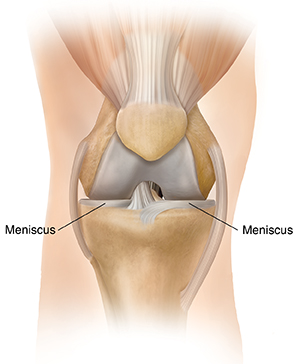
Your knee has two wedge-shaped pieces of cartilage. They lie on each side of your knee. Each piece is called a meniscus. They act as shock absorbers between your thighbone (femur) and your shinbone (tibia). The rubbery menisci help protect the ends of your bones as they move together.
A twisting injury may badly damage your meniscus. It may need to be removed if the damage is bad enough. Without this cushion, the ends of your bones may start to rub together. This can cause knee pain and arthritis over time.
Why meniscal transplant surgery is done
Meniscal transplant surgery may be done if your meniscus was taken out in a past surgery. With no meniscus, you may get knee pain and arthritis of the knee. Replacing it may give you pain relief. It may also help prevent arthritis. This surgery is less invasive than knee replacement surgery. But it may not be an option if you already have arthritis of your knee.
Meniscal transplant surgery may be a choice if you:
-
Are age 45 or younger and physically active.
-
Are missing a large part of your meniscus.
-
Have a large meniscus tear that can’t be repaired.
-
Have severe or ongoing knee pain with activity.
-
Have no or only a small amount of arthritis.
-
Have a knee with normal alignment and stable ligaments.
-
Are not obese.
How meniscal transplant surgery is done
Your surgery will be done by an orthopedic surgeon. This is a surgeon who specializes in treating bone, muscle, joint, and tendon problems.
The surgery can be done in several ways. The surgeon will make one or more small cuts (incisions) through the skin and muscle of your knee. The surgeon will put a very small camera through this cut. This is used to help guide the surgery. Any remaining meniscus is removed with very small tools put through the cut. The surgeon will stitch the donated meniscus into the joint. Screws or other devices may be used to hold it in place.
Risks of meniscal transplant surgery
All surgery has some risks. The risks of this surgery include:
-
Stiffness of the joint after surgery (more common).
-
Incomplete healing and need for another surgery.
-
Too much bleeding.
-
Infection.
-
Damage to nearby nerves.
-
Problems from anesthesia.
-
An infection from the donated tissue (very rare).
Your own risks may be different based on your age, overall health, and other things. Ask your surgeon about the risks that most apply to you.
Featured in