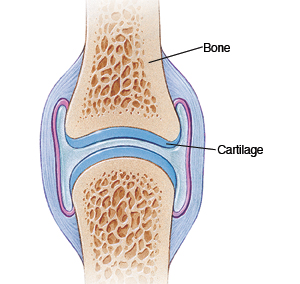
You have a joint dislocation. This happens when a strong force is applied to the joint, tearing ligaments and forcing the bones out of place. Often no bones are broken. But the nearby nerves and blood vessels can be damaged.
Once the joint is put back in place, it will take at least 6 weeks for the ligaments to heal. Range of motion exercises or physical therapy may be prescribed early in your recovery. This is to prevent the joint from getting stiff. Later, strengthening exercises may be added.
In more severe cases, surgery may be needed to realign the joint and repair the torn ligaments or any broken bones. After a dislocation, the joint may not regain full range of motion or heal fully. Also, if the joint surface was fractured or broken, you are at risk of getting arthritis in that joint.
Home care
-
If you were given a sling or splint, wear it until your next health care provider visit. Don’t take it off at night to sleep. It is possible to re-injure the joint while you sleep. Unless told otherwise, you may take off the sling or splint to bathe or dress.
-
If no bones were broken, it’s important to begin moving the joint during the first few weeks after the injury. This is to help prevent the joint from getting stiff. On your next visit, ask your provider when you should begin some exercises.
-
Apply an ice pack to the injured area for no more than 20 minutes. Do this every 3 to 6 hours for the first 24 to 48 hours. Keep using ice 4 times a day for the next few days until the pain is better. To make an ice pack, put ice cubes in a plastic bag that seals at the top. Wrap the bag in a clean, thin towel or cloth. Never put ice or an ice pack directly on the skin. You can place the ice pack inside the sling or over the splint. As the ice melts, be careful that the sling or splint doesn’t get wet.
-
You may use over-the-counter pain medicine to control pain, unless another pain medicine was prescribed. Talk with your provider before using these medicines if you have chronic liver or kidney disease, ever had a stomach ulcer or GI (gastrointestinal) bleeding, or take blood thinners.
Follow-up care
Follow up with your provider in 1 week, or as advised.
If you had X-rays or a CT scan, you will be notified of any new findings that may affect your care.
When to contact your doctor
Contact your provider right away if:
-
There is increasing swelling or pain in or around the injured joint.
-
Your affected arm or leg becomes cold, blue, numb, or tingly.
-
You have redness, warmth, fever, or chills.