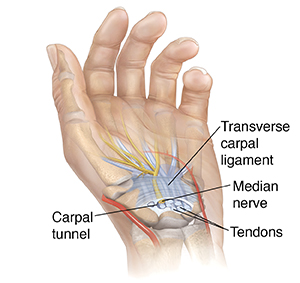
The carpal tunnel is a narrow space inside the wrist. It is ringed by bone and a band of tough tissue called the transverse carpal ligament. A major nerve called the median nerve runs from the forearm into the hand through the carpal tunnel. Tendons also run through the carpal tunnel.
With carpal tunnel syndrome, the tendons or nearby tissues within the carpal tunnel may swell or thicken. Or the transverse carpal ligament may harden and shorten. This narrows the space in the carpal tunnel and puts pressure on the median nerve. This pressure leads to tingling and numbness of the hand and wrist. After some time, the condition can make even simple tasks hard to do.
What causes carpal tunnel syndrome?
Healthcare providers aren’t entirely sure why the condition occurs. Certain things may make a person more likely to have it. These include:
-
Being assigned female at birth
-
Being pregnant
-
Being overweight
-
Having diabetes or rheumatoid arthritis
-
Doing certain motions over and over (repetitive)
Symptoms of carpal tunnel syndrome
Symptoms often come and go. At first, symptoms may happen mainly at night. Later, they may be noticed during the day as well. They may get worse with activities such as driving, reading, typing, or holding a phone. Symptoms can include:
-
Tingling and numbness in the hand or wrist
-
Sharp pain that shoots up the arm or down to the fingers
-
Hand stiffness or cramping, especially in the morning
-
Trouble making a fist
-
Hand weakness and clumsiness
Treatment for carpal tunnel syndrome
Certain treatments help reduce the pressure on the median nerve and relieve symptoms. Choices for treatment may include 1 or more of the following:
-
Wrist splint. This involves wearing a special brace on the wrist and hand. The splint holds the wrist straight, in a neutral position. This helps keep the carpal tunnel as open as possible.
-
Cortisone shots. Cortisone is a medicine that helps reduce swelling. It is injected directly into the wrist. It helps shrink tissues inside the carpal tunnel. This relieves symptoms for a time.
-
Pain medicines. You may take over-the-counter or prescription medicines to help reduce swelling and relieve symptoms.
-
Surgery. If the condition doesn’t respond to other treatments and doesn’t go away on its own, you may need surgery. During surgery, the surgeon cuts the transverse carpal ligament to relieve pressure on the median nerve.
When to call your healthcare provider
Call your healthcare provider right away if you have any of these:
-
Fever of 100.4°F (38°C) or higher, or as advised
-
Symptoms that don’t get better or get worse
-
New symptoms
Author: Michels, Karen
© 2000-2025 The StayWell Company, LLC. All rights reserved. This information is not intended as a substitute for professional medical care. Always follow your healthcare professional's instructions.