You’ve had a cesarean section birth. Now you may wonder if you can try vaginal birth with your next baby. It’s likely you can. TOLAC (trial of labor after cesarean delivery) is often a success. A successful TOLAC leads to vaginal birth after cesarean delivery (VBAC). To find out more about TOLAC, read this health sheet. Then discuss it with your healthcare provider.
Is TOLAC right for me?
TOLAC may be right for you if:
-
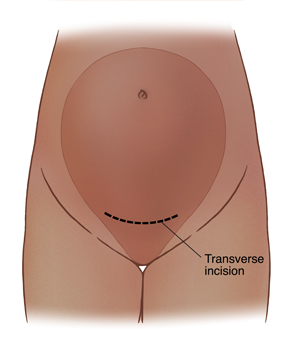
A low transverse (side-to-side) incision in the uterus was used for all your cesarean section births. (Be aware: Your skin incision may not match the incision in your uterus.)
-
You have no health problems that would prevent a VBAC.
-
The baby is in a normal head-down position.
How can I benefit?
When compared with a cesarean section delivery, VBAC has certain benefits. These include:
-
A shorter recovery. With VBAC, you won’t have an incision in your stomach. This means you should feel better faster than the last time you gave birth.
-
Fewer health risks. VBAC reduces the chances of excess bleeding, infection, and death.
Is TOLAC safe?
For people who try VBAC, there is a risk of cesarean section scar rupture (when an incision site pulls apart). Uterine rupture happens in about 1 out of 100 to 200 cases.
Prepare for TOLAC
As with any birth, this birth will go more smoothly if you are prepared. Make sure the hospital where you will have your baby is friendly toward TOLAC. Also be sure your support person is committed to helping you:
-
Work closely with your healthcare team. They support you and your choice to try TOLAC. They will do all they can to promote a safe, healthy birth.
-
Talk with your healthcare provider about your choices for anesthesia and other ways of controlling pain.
-
Pick a dedicated support person. They can motivate you to help labor progress.
-
Refresh your skills. Take a childbirth class. Learn ways to relax, how to breathe through pain, and how to push.
-
Be prepared for possible changes in your delivery plan.
Know what to expect
With TOLAC, you are likely to be told to leave for the hospital as soon as labor begins. After you are admitted, you may have a blood test as well as an exam. An IV (intravenous) line might be started to supply fluids or medicines. Throughout labor, you and your baby will be carefully watched to make sure of your well-being.