Dismiss Modal

Treatment

Before Total Hip Replacement: Your Conditioning Program

Choose a preferred language

Conditioning your body before hip replacement can help speed your recovery. Daily exercise helps strengthen muscles that support the hip joint. Aerobic activity (exercise that raises your heart rate) can improve fitness. It can also help you reach or maintain a healthy weight, reducing stress on your hip.

Before beginning any exercise program, talk with your healthcare provider.


Low-impact exercise

Low-impact exercise can help improve your fitness with less stress on the hip joint. Try exercises like swimming, water aerobics, walking, or riding a stationary bicycle. It’s normal to feel a little discomfort in your hip joint. But stop any exercise that causes increasing pain. You can also ask your healthcare provider or physical therapist about ways to manage pain during exercise.


Pool exercise

Working out in a pool is a gentle way to exercise muscles with less stress on the joints. It can also improve balance and coordination. A physical therapist may work with you in a pool therapy program. You can also try pool walking on your own. Stand in waist-deep to chest-deep water with your arms out to the sides. Then slowly walk forward. To prevent overdoing, ask your physical therapist how long to exercise. They can also give you tips on pool safety.
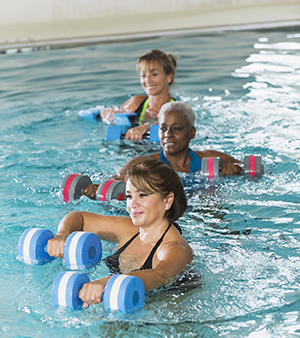
Three women exercising in swimming pool.


When to call your healthcare provider

Contact your healthcare provider if:

  • Any exercise causes increasing pain or swelling in your hip

  • You’re not sure how to safely do an exercise

  • You need help learning to use your walker or crutches

© 2000-2025 The StayWell Company, LLC. All rights reserved. This information is not intended as a substitute for professional medical care. Always follow your healthcare professional's instructions.
Related Articles
Read article
Orthopedics
Hip Arthroscopy: Repairing Femoroacetabular Impingement

When excess bone forms on the edge of the ball or the socket of the hip, it's called FAI (femoroacetabular impingement). This can cause pain and limit movement. Arthroscopy can fix FAI. It uses small incisions and special tools. Read on to learn more.

Read article
Orthopedics
Cortisone Injections

Injecting cortisone can relieve pain for anything from a sports injury to arthritis.

Read article
Orthopedics
Cervical Epidural Injection: Your Experience

Cervical epidural injection is a treatment for certain types of neck pain. Learn what to expect before, during, and after this treatment.

Read article
Orthopedics
Foot Surgery: Bone Spurs

A bone spur (an extra bone growth) can make walking and wearing shoes painful. There are several nonsurgical treatments for bone spurs. But if these aren't effective, surgery can be considered.

Our orthopedic specialists will get you moving pain-free again.

From orthopedic surgeons to physical therapists, our orthopedic team has been built to provide seamless care and support throughout your whole journey.

Browse our specialists